If you are an author, you do not just want “more followers.” You want real readers who trust you, enjoy your work, and feel excited for your next book.
That kind of connection is not magic. It is built through small actions that repeat over time.
This guide shows you practical ways to connect with readers, even if you are shy, busy, or brand-new. You will also get simple steps you can start today.
What readers really want from authors
Most readers are not looking for a perfect “author brand.” They want:
- A story they enjoy
- A clear reason to care (emotion, meaning, fun, hope, lessons)
- A human behind the book (your voice, your values, your journey)
- A place to stay connected (so they do not forget you)
The pain point for many authors is this: “I post, but no one responds.”
That usually happens when content feels random or sales-heavy.
A better plan is to focus on one simple goal:
Help readers feel seen, helped, or entertained.
The strongest connection starts before you promote anything
Step 1: Know who your reader is (in plain words)
You do not need a big marketing document. Answer these:
- What kind of person loves my book?
- What problem or feeling does my book speak to?
- What do they search for online?
- Where do they hang out (Facebook groups, BookTok, newsletters, local events)?
If you write devotionals, your reader may want comfort, guidance, and hope.
If you write thrillers, they may want suspense, clues, and twists.
When you know this, your content becomes clearer and readers feel, “This is for me.”
Step 2: Pick 1–2 “home bases”
Trying to be everywhere is exhausting.
Choose:
- One main social platform (where your readers already are)
- One “owned” platform you control (usually an email newsletter)
Why newsletter? Social algorithms change. Email is more stable.
Also, a lot of adults use social media, so being present there can help you get discovered. Pew Research reported that 68% of U.S. adults use social media.
10 practical ways authors connect with readers
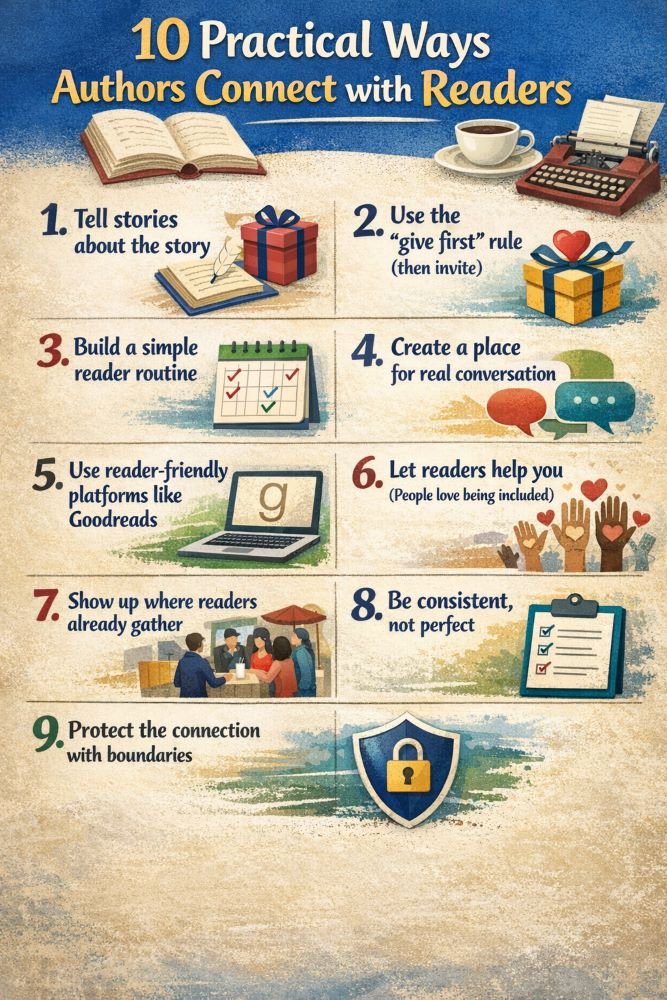
1) Tell stories about the story
Readers love behind-the-scenes moments.
Share:
- What inspired the book
- A “this almost did not make the final draft” scene
- A character you relate to and why
- A lesson you learned while writing
Keep it simple and short. One clear point per post.
2) Use the “give first” rule (then invite)
If every post says “Buy my book,” people tune out.
Try this pattern:
- Give value (tip, insight, short story, quote, funny moment)
- Invite them (soft CTA)
Examples:
- “If you struggle with forgiveness, here are 3 questions that helped me. If you want a deeper story, my book is linked in my bio.”
- “This character was born from a real moment in my life. Want to meet her? Chapter 1 is free on my site.”
3) Build a simple reader routine
Connection grows when readers can expect you.
Pick one:
- “Monday: 1-minute reading”
- “Wednesday: writing update”
- “Friday: reader question”
This helps readers remember you without you posting all day.
4) Create a place for real conversation
Social posts are fast. Communities go deeper.
Options:
- Facebook group
- Discord server
- Monthly Zoom reader hangout
- Local library book club visit
Virtual events can work too. Eventbrite shared that 41% of attendees reported attending a virtual event (2021–2023).
That means many people are comfortable showing up online.
5) Use reader-friendly platforms like Goodreads
Readers already talk about books on book communities.
Goodreads is huge. Penguin Random House’s author marketing tip notes Goodreads has more than 150 million members.
Simple actions:
- Claim your author profile
- Add a short, warm bio
- Post updates only when you truly have something to share
- Run a giveaway (if it fits your plan)
- Thank reviewers (without arguing or pushing)
6) Share short readings (and make them easy to watch)
You do not need fancy video.
Try:
- 30–60 seconds reading a strong passage
- One quote on screen with your voice
- A “reader hook” line, then: “Want the next part?”
Tip: Use captions. Many people watch with sound off.
7) Let readers help you (people love being included)
Connection grows when readers feel like insiders.
Ideas:
- Poll: “Which cover do you like?”
- “Name this side character”
- Ask for favorite quote moments
- Invite beta readers or ARC readers (with clear rules)
Readers who help you are more likely to support you.
8) Show up where readers already gather
Instead of building everything from zero, borrow a room that already exists:
- Podcasts (guest interviews)
- Book clubs
- Local schools, churches, or community groups (if relevant)
- Book fairs and author panels
Even audio matters for attention. Nielsen reported that audio took nearly 20% of Americans’ daily media time in Q4 2024, about 3 hours and 54 minutes.
That is a big reason podcasts and audio interviews can help readers feel close to you.
9) Be consistent, not perfect
A lot of authors stop because they think they are “not good at marketing.”
Readers do not need you to be viral. They need you to be real and steady.
A simple weekly plan beats a perfect plan you quit in two weeks.
10) Protect the connection with boundaries
This part is important.
Connection does not mean access to you 24/7.
Healthy boundaries:
- Do not argue with negative reviews
- Do not reply to every comment
- Create office hours for messages
- Keep private life private when needed
Readers respect authors who are kind and clear.
A simple weekly plan (easy to follow)
One hour a week can be enough.
Day 1 (15 min): Write 2 short posts (value first)
Day 2 (15 min): Reply to comments, thank readers
Day 3 (15 min): Send a short newsletter or update
Day 4 (15 min): Do one “connection action” (podcast pitch, book club invite, Goodreads update)
That is it. Simple and repeatable.
Quick checklist: Are you connecting or just promoting?
You are connecting when you:
- Share stories and meaning
- Ask questions and listen
- Offer something helpful or entertaining
- Invite readers into your world
You are only promoting when you:
- Post links with no context
- Talk only about yourself
- Show up only at launch time
Aim for 80% connection, 20% promotion.
FAQs about how authors connect with readers
1) How can shy authors connect with readers?
Start with low-pressure options: a monthly newsletter, short written posts, or pre-recorded videos. You do not need live speaking to build trust.
2) What is the best social media platform for authors?
The best platform is where your readers already spend time. Many authors do well on Facebook, Instagram, TikTok, or YouTube, but you should choose based on your audience and comfort.
3) Do I really need a newsletter?
If you want a long-term reader relationship, yes. Social media can help you get discovered, but email helps you keep readers close, even when platforms change.
4) How often should I post?
Consistency matters more than quantity. If you can only do 2 posts a week, do 2 posts every week. That is better than 10 posts one week and then nothing for a month.
5) Should I respond to every message and comment?
No. Respond when you can, but set boundaries. Readers value kindness, not instant replies.
6) What if no one engages with my posts?
That is normal at first. Improve one thing at a time:
- Make posts more specific to reader needs
- Ask one clear question
- Share a short story, not a general statement
- Keep going for 8–12 weeks before judging results
7) How do I connect with readers without sounding salesy?
Use “give first” content: tips, insights, behind-the-scenes, or a short reading. Then add a gentle invitation like “If you want more, the link is in my bio.”
Your story deserves this stage. Join the festival as a featured author, share your narrative with a global audience, and connect with fellow storytellers and readers.
Apply to Be a Featured Storyteller →A limited number of spots are available for authors.